Thursday, May 19, 2016

Missoula, part II

Sometimes it's hard to get outta Dodge. 
Or Missoula.

Writing and organizing and going through photos takes a lot of time. My lament is that I'd rather be out experiencing things rather than writing about it, but I'm committed. So I hope you all enjoy this. Please feel free to comment or ask questions! I'll answer if I can.


One of the original fort structures. 

Ft. Missoula

Having gotten the letterboxing bug, and not knowing when I'd find additional ones later in the trip, I decided to chase after some additional boxes in Missoula.

Besides, they usually lead you to unusual and interesting places. One was supposed to be at Fort Missoula.

Steam train at Ft Missoula
Like most forts on in the American West, Fort Missoula was established in 1887 to offer settlers military protection. Today, it houses a historical museum, plus extensive outdoor exhibits. Sadly, it was too late in the day to see the exhibits inside, but I had fun wandering around the grounds and looking at all the diplays.

A lot of the exhibits have to do with logging. There is a "mobile" sawmill, a sawdust burner (seriously HUGE, as I've seen them from afar, but never been close to one), a steam train showing how logs were loaded and carried by rail, plus a large number of other machines used in logging and farming. 

"High wheel" logging contraption
Some of these machines have been lovingly restored. There are about ten tractors from 1910-1940, a locomotive, hay baling machines, a primitive backhoe, and lots more. One of the more unusual was a "high-wheel" that used draft horses to move really large logs — the logs were balanced on a chain underneath the long tongue. I guess if there wasn't a flume to move logs that this was a better alternative than dragging them!

As part of the Dept. of Forestry exhibit, there were also two fire lookouts that had been transferred here in their entirety. One was a tower, the other a rustic cabin. You actually could climb up on the tower. I got part of the way, and then decided to retreat. The stairs were a bit too rickety for my taste!

I'm quite taken with log structures. While they share common construction, each one is different: as unique as the person who hewed the logs and muscled them into place. Some are carefully notched, others aren't made with precision. But they are strong and made from local materials (wood, stone, mud). How many of us can say the same about our houses now?
One of the log fire lookout cabins.
Note the steep roof for Montana snows!

Besides, who doesn't love structures that remind us of playing with Lincoln Logs?

NOTE: I did discover the hidden letterbox here — it was on one of the train cars.

Iris Garden

While at Ft. Missoula, I almost missed the display garden of the Missoula Iris Society! It was beautiful garden of mounded beds and included historical iris, dutch iris, Siberian iris as well as bearded iris. And some that I've never heard of. 

Part of the iris display garden at Ft Missoula
There were iris of every color of the rainbow: pink, purple, blue, pale green, yellow, orange, rust, coral, and combinations of everything in between. 

I caught the garden about mid-bloom: some plants were spent and done blooming, but there were others that hadn't bloomed yet. It made me want to come back... like tulips, if you plant enough of them, you'll have iris for a month!

There were a few other bulbs, too; what gardener can resist? The daffodils and narcissus were done. No tulips that I could see. I rather think the deer would eat them! The iris seem to be immune — something for our Marin gardeners to contemplate!


Suffice to say that I was entranced, and just a little sad. 
"Non-bearded iris" at the display garden.
This was something of a bittersweet tour, as I do so miss the iris — and all the garden — I had back at the Larkspur house. The heralds of spring were the yellow, white and blue dutch iris, followed by the bearded iris. The first of those to bloom was rust brown with bright orange "beards." It looked like a blazing torch in the garden. It was followed by a white iris that had purple flecks, and another that was magenta and brown, similar to the one above. And there was a Pacific coast hybrid that was such a deep, deep purple that it looked like velvet. I am so sorry that all those plants are just gone. Cuts to the bone, so it does!

Prairie Dogs

Lastly, I have to mention the prairie dogs. If you ever have the opportunity to take some time to watch these little animals, I encourage you to do so. They are hilarious, scampering over the lawn, sitting up and chirping at intruders. 

I know that the settlers and cowboys hated them, since if you're racing a horse across a prairie dog town, your horse could easily break a leg in the holes. But as an observer without a fast horse to worry about, they are pretty darn adorable and funny, chasing each other around. 

The Lucy home: one of the historic houses near the University

More Letterboxes

There is so much to see! Even though it was the end of the day, it is light so long here (to 9:30pm) that you have a lot of time for outdoor activities. And it was (at last) a beautiful day with sun and pleasant temperatures.

Several of the letterboxes were near the University of Montana. Parking there is a problem, so it was time for a nice walk to explore the area. I parked the car along one of the residential streets (not in a controlled area) and set off. 

The vintage houses and shaded streets remind me of "Professorville" in old Palo Alto. Architecture is quite varied. I did not notice any "new" houses — it seems like any renovations are modest, or on the inside. 

A typical letterbox...
but the stamp was missing!
The first letterbox I wanted to find at Madison Park was a bust. The bridge over the river was closed off, so there was no way I could get at it. BUT, it introduced me to the lovely River Walk along the Clark Fork River. Students, dog walkers and others just out for a stroll enjoy this pathway, as well as bike riders. There are a lot of bike riders. The main part of Missoula is pretty flat, so it's an ideal place to ride a bike (except in the winter, although some people do bike all year round). I'm happy to report that along some streets there are separated lanes for bikes, people and cars. I would love to see this happen in Marin!

The second letterbox was at the Phyllis J. Washington memorial, right near the historic President's House, a lovely Victorian built around the turn of the century. Unfortunately, although the letterbox was there, the custom stamp inside had been stolen. I was disappointed, but signed the logbook anyway. It's near the busy trail to the top of Mt. Sentinel (with the big "M" for Missoula), so it may be that someone found it and took it. It happens.

I could easily spend more time here... but I'm going to leave that for another time, as I hope to be back and have more time to explore.

I spent another night "camping" in Missoula, with the idea that I'd head out to the National Bison Range the following day. Weather is coming in, and I'd like to have a good day for that expedition!


Wednesday, May 18, 2016

Missoula!

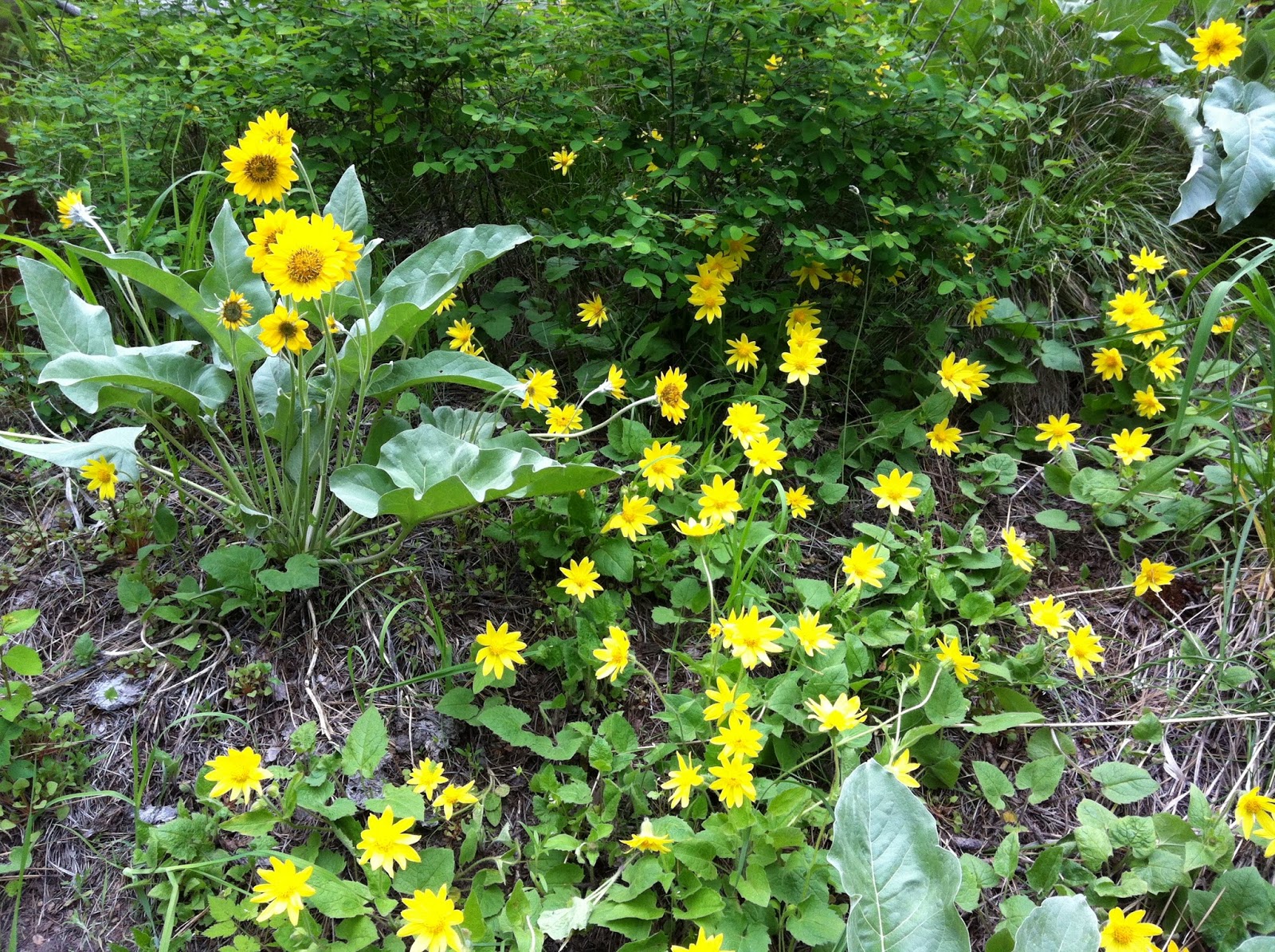
Arrowhead balsamroot & arnica in Pattee Canyon
It's been over 20 years since I last saw Ted and Michele. My kids (and I) have very fond memories of our last visit to Missoula, which included huckleberry picking and huckleberry pancakes, and Fourth of July fireworks out in the street!

While at UCSB, Michele was my next door neighbor, and we were good friends. Both were in the Geology Department there, and I was a bridesmaid in their wedding.

Time passes, children grow up, and we didn't correspond much. But some friendships go very deep. I am touched to find this to be true feel very blessed.

Fields of balsamroot
When I got there (finally), Michele was working late at recital practice, so Ted took me and the dogs for a walk up Pattee Canyon. The camas, lupine, balsamroot and arnica were in bloom, and the fields of color were beautiful.

Ted had baked an amazing patitsa: an enormous Slovenian sweet bread spiral filled with nuts, honey, raisins and his secret ingredient (crushed graham crackers). This one was baked in a turkey roasting pan, so that gives you some idea of how big it was! He's been working on the formula for the best possible bread, and this one was darn good.

Their son, his wife and 7-month-old baby were visiting from Bozeman, so between that and the end of the quarter and recital for Michele, it may not have been the best time to visit, but they were gracious hosts. They opened their home and their hearts to me, and it was a wonderful visit.

Ted's sister lives nearby and she came to visit and play with the baby, too.

So I got filled with good food (sourdough waffles! bison pot roast! elk meatballs!), family love, local lore of mining and historical characters, doggie kisses, and long hours of talking, walking, and catching up and just sharing about life and the years between that we've missed.

Rainbow above fields of camas
I was even able to attend the student recitals. Michele is the artistic and creative director for the Ballet Arts Academy, and the culmination of the year is TWO recitals. Both were amazing performances. I wished I'd brought the camera. From the little "pre-ballet" kids in their little pink tutus, to the accomplished senior performers, it was a heartwarming and beautiful experience. I was so glad to see it, and Ted gave an amusing running commentary that added to the background.

I introduced Ted to letterboxing, and we hiked up to the "Grandfather Tree" to find two letterboxes! He's intrigued by this, especially as an activity for the grandchildren, so we may have another convert, Linda! I rather think he might even become someone who plants some boxes, as one of his interests is local history. If you want to know more, he is co-editor of a blog: Granite County History.

There are several more letterboxes in Missoula, and I hope to find them before I leave.

But for now, it's time to leave and head north. I plan to visit the National Bison Range and several wildlife refuges, and maybe camp at Flathead Lake. Weather is coming in, though, so we'll see how things go.

That's life on the road!


Saturday, May 14, 2016

Lemhi River & Sacagawea Center

Putting the design on the eraser before carving.

Letterboxing

One of the things that I researched was letterboxes. Linda Varonin introduced me to this hobby, and I needed to carve a new stamp for myself, since my original one had been lost in the Great Move.

It was pleasant to sit at one of the tables in the local park by the rushing river, munching on an outstanding crisp almond croissant from the local "Odd Fellows Bakery" and carve my new stamp from a lowly eraser. It's not the best medium for doing this, but it works.
Finished stamp.

Carving is a little nerve-wracking because if you make a mistake, there's no going back. Once a piece has been removed, it's gone forever. If the knife slips, you either have to start over, or just live with it.

My letterbox handle is "LarkspurLass."

Sacagawea Interpretive Center


I wanted to visit the Sacagawea Interpretive Center anyway, but having a letterbox hidden there was an added incentive to go and explore. The Center is located there because the Lemhi Valley is the birthplace of this remarkable woman. Captured by the Hidatsa when she was about young, she was married to Jean Paul Charbonneau a French trapper when she was only 13. Charbonneau was hired by Lewis & Clark, so he and Sacagawea acted as guides for the expedition. She walked thousands of miles as a teenager, had a baby en route, and was instrumental to the success of the explorers because of her facility with languages, familiarity with the landscape and other tribes. She died when she was only 25 years old, although this is uncertain and there are other claims that she died in 1884 rather than 1812. Regardless, it's an amazing story.

Pair of Sandhill Cranes at the Sacagawea Center
This is a shoulder season, so I was pleasantly surprised to find that the Center was actually open, even though hours were not posted as such. So I got to see the exhibits and buy a few postcards, as well as chat with Carmen, the friendly and informative lady who was there. 

The Center emphasizes education, so there is a lot of information that's oriented towards kids. One little boy was quite fascinated by the flintlock rifle there: "It WORKS!" he exclaimed delightedly, showing off his prowess in firearms by pointing it out the window and pulling the trigger. He was also very pleased to wear the coonskin cap, prancing around with rifle in hand. It was impossible not to smile.

Aigadika sweat lodge
In the summer, the Center expands their offerings to teach workshops flint knapping, basketweaving, and other native arts. I would love to attend!

Besides indoor exhibits, you can wander along several outside interpretive trails. There are examples of several different Aigadika Shoshone structures: tipis, wikiups and even a sweat lodge; a log cabin and corral; and a wealth of information on natural history, especially on salmon and various roots, which were so important to the local tribes as a food source.

I was excited to see a couple of sandhill cranes, a robin, a mourning cloak butterfly and a number of other birds and animals.

Pretending to get into the "gah tine"
through the "mother poles"
And I found the hidden letterbox!

It was with some regret that I left to head north to Missoula, but I'd told Ted and Michele that I'd be there in the late afternoon. I WILL be back to explore Traveler's Rest and some of the other areas that I didn't have an opportunity to visit on this trip...

I'm beginning to sound like Arnold Schwarzenegger with the familiar refrain, "I'll be back!"
Robin -- not an unusual species,
but I'm getting the hang of the camera!


Lemhi River and Bitterroot Range
from near "Grandma Maudie's" letterbox


Friday, May 13, 2016

Salmon, Idaho

Grrrr. Had started to write this post, left it and lost everything. So this is somewhat abbreviated.

Unusual bi-color lilac at the Inn.
The scent of lilacs perfumes this little town, especially in the evening.

Sacagawea Inn

I'd booked a room at this little motel so that I could participate via FaceTime in a book club meeting.

The proprietoress was friendly, there was a resident black "motel cat" named Lily, a German Shepherd, too. I felt right at home!

I was given the "Bear Cub" room, complete with a mural of a mama bear and her two cubs in a forest scene on the wall above the bed. There were even sculpted bears on the toilet paper holder and light switches!

It was nice to get a shower and have unlimited power for once. I'm always having to be conscious of a draining battery!

Bathroom at the Sacagawea Inn. Note the origami towels!
The bathroom was charmingly dated with pink tile and pink ersatz marble formica around the sink. The towels were folded like nothing I've ever seen! I thought it was very comfortable and homey, complete with handmade afghan thrown over a sitting chair, a small garden with flowers, and a $3 breakfast with eggs, bacon, potatoes, toast and coffee.

The book club connection was not as successful as I would have liked — while FaceTime worked for a time (I was a disembodied Cheshire presence on Becky's phone), the video was jerky and kept dropping off. We opted for audio instead, but I still missed about 20% of the meeting. I'd like to try Google Hangouts or Skype next time.

Lilacs and hawthorne in Salmon
I ended up staying in Salmon for a few days (two nights at the motel and a couple "camping"). There was a brand-new library in town, just completed in 2015. In fact, they were just placing the sign for the library outside!

The library seemed to be something of a crossroads for locals, with topics of conversation ranging from the weather ("All my tomatoes froze," lamented one gentleman), to fishing, town politics, and cars. The library was well outfitted with computers, sitting areas, books, and best of all: tables to work at with ample plugs for power and fast wifi. I ended up working there, writing and researching for a couple of days.


Evening history walk

The library is also a great source of town information. You don't find everything online!

There was a great little brochure on a history walk, highlighting a number of historical structures around town. So as the sun set, I went for a walk to get to know the town a bit better. Dusk lasts for a long time — the sun sets about 8:30pm, but it doesn't really get dark until after 9:30pm.
Sunset over the Bitterroot Range; Salmon River in the foreground

As I walked, the scent of lilacs perfumed the air. They were flowering exuberantly everywhere: deep purple, lavender, maroon and white. The aroma will always bring back memories of Salmon, Idaho.


This home wasn't on the tour, but is typical of homes in town.
History Park was tucked away between a pizza joint and a real estate building, and it was interesting to read the exhibits about the native Americans, trappers and explorers, Mormon missionaries, miners and merchants, including those who became prominent citizens of the area, like George Shoup, a merchant and rancher who became territorial governor and then senator of Idaho.

Idaho and Montana (and South Dakota, too), have had boom and bust years from gold, silver, lead, and copper mining, as well as from logging. 


Main Street, Salmon, Idaho
I think the earliest building on the tour was from the 1880s. Most buildings featured were from the turn of the century since there was a building surge then, mostly fueled by mining interests.

Lemhi County Courthouse in Salmon, ID
Lots of brick, with interesting pediments and ornamentation. Of course, churches were important, too, and the courthouse, a massive brick building built in 1909, is on the National Register.

Salmon River and Island Park

The other thing about Salmon, Idaho, was that it seemed to be a safe, friendly small town. 

Kids were laughing, shouting and playing outside, riding bikes and skateboards until dark, with nary a parent hovering in the background.

Rafters on the Salmon River at dusk.
There was a skateboard park on Island Park, located between arms of the Salmon River and accessible via a sturdy pedestrian bridge.

Dog walkers made good use of this park, too. Curiously, the only hours that were posted as "on leash" hours were 11:30am-1:30pm. I wondered if that was because people often took lunchtime there and didn't want to be accosted by exuberant, wet dogs?

The Salmon River was running high and swift. A few rafts were running the rapids and passed by faster than I was walking.

I had to laugh at a couple of mallards that looked for all the world like they were enjoying running the rapids, too. They sped downriver, bouncing up and down the waves, and as soon as they passed into relatively still water, paddled furiously to get to the side of the river where the current was less so they could swim back upstream. I swear they were going to do it all over again, just for the sheer enjoyment of the speed and an adrenaline rush.

The area is on the Idaho Birding Trail, and the trees and brush were full of twittering birds, especially at dusk. I spotted an osprey, too. It was pretty magical!

Heron at dusk


Osprey at dusk

Tuesday, May 10, 2016

Sawtooth Mountains!

Boulder Mountains from the Wood River
I have always wanted to come to the Sawtooth area. Often when I've seen a picture on a calendar of a beautiful spot that I don't recognize, often as not the caption has said "Sawtooth Wilderness."

I can't believe I'm really here!

Morning in the mountains

Woke up to weak sun and cold temperatures. The car thermometer was reading 32°F.

But OH, what does the temperature matter when you can see such sights? The Boulder mountains border the Wood River valley on the east, and they are gorgeous mountains... especially with new snow! This route is known as the "Sawtooth Scenic Byway," and boy, is it ever!

Looking back at the Boulder Mountains from near Galena summit
State route 75 follows the Wood River generally north, climbing gently. Instead of getting warmer as the morning went on, the temperature dropped to 27°F. (probably in part because of gaining altitude), but at least the sun was out part of the time, and it wasn't nearly as windy as it was yesterday.

If it hadn't been so cold, I would have stopped more frequently, but instead just drove slowly and drank in the beauty of the place. (I was also feeling a little uneasy at this point, as the tire-pressure light came on... the tires didn't look under-inflated, but it was worrisome. I thought it might have to do with the cold weather, but even driving and the heat of friction didn't make the light go off.)

I'm pretty sure I saw a couple of cranes flying overhead at one point. At another meadow there was a herd of deer gamboling in a meadow — they looked like kids out of school or dogs at the dog park, jumping stiff-legged and scampering off then shaking their heads and looking behind to see if their friends would play chase. Totally made me laugh. And the next time (yes, there WILL be a next time), I'll check out the "Billy Bridge" that's supposed to be a place where you can view mountain goats. I'm sure I'll see more in Montana and Alaska, so I didn't stop.

Galena summit: looking to the headwaters of the Salmon River
and the Sawtooth mountains in the distance

Galena Summit 

Once over the summit, the valley on the other side opens up. Here are the headwaters of the Salmon River, also known as the "River of No Return," so called because on their way west Lewis & Clark found the river unnavigable. This forced them to abandon their boats and get horses from the Shoshone to continue their voyage.
.
The Sawtooth range lies to the west, and it is beautiful. What is it that makes some mountains so pleasing?


Apparently a lot of other people think it is beautiful, too. While there obviously are working ranches, there is also increasing development: a few monster homes, some "ranchettes," and a number of what appear to be "vacation" developments encroaching onto the National Forest land. I've seen this pattern in Nevada and Utah, too, and it's a little unsettling to see the demarcation lines between private and public lands so evident. 


Pronghorn! (before it started running)
I felt lucky to see a herd of pronghorn grazing in the valley — the first I've seen on this trip. They are actually fairly common, but it's always a treat to see them. They are very, very fast runners, reputed to be able to maintain 55mph for a half mile.

Alturas Lake

It wasn't getting all that much warmer, despite coming down in elevation and also being later in the morning, so I decided to just go ahead and stop for late breakfast at Alturas Lake.

Beaver lodge & pond. Yes, that's ice on the water!
It's a pretty lake, and had it been warmer, I would have been tempted to put the kayak in the water; as it was there was about an inch of snow on the outhouse roof! Everything is still closed for the winter.

I hiked around a bit nearby the lake and discovered an extensive beaver pond with a lodge in the center. There was ice on the water! No beavers swimming around (not sure how much they come out now), but it was still fun to see. Once again, I marveled over the sturdiness — or foolhardiness — of the mountain men who willingly entered the freezing water in order to trap them.

Snow falling on the Sawtooth across the Salmon River valley.
A woodpecker was hammering on one of the trees, but only heard it, never saw it.

I next tried to get into Fourth of July Lake, as I'd heard there was a nice hiking trail there, but... I hit snow on the road, and it was evident from the tire tracks that the previous person who had tried to come in this route turned back. Between this, and the fact that the weather was turning a bit for the worse, following their example seemed the prudent thing do.

On the way out, there was a bright flash of blue — a mountain bluebird!


Falling snow obscuring the gorgeous view

Redfish Lake

Redfish Lake is named because of the number of chinook salmon that used to spawn here. Legend has it that you could walk across the lake on the backs of the fish!

The salmon that swim up the Salmon River have one of the longest migrations of fish anywhere in the world — over 800 miles from the Pacific Ocean upstream to their spawning grounds, fighting eight major dams on the way. Of course, there are far fewer of them now, but they are making a comeback. Salmon fishing season here is for three weeks in July.

Not what one expects to see... dead bird in the WC
Redfish Lake is a gorgeous lake; it must be crowded during the summer. There are many campgrounds and picnic areas around it, but now pretty much everything was closed. On this day, only one other couple, and their dog, was here.

Just one men's toilet was open (none of the women's), and it held a surprise and something of a mystery: HOW did that dead bird get in there? (Or, presumably the bird was alive when it got in, and then succumbed to... something. And then the question is, what ate it, and how did IT get out, since the door was quite securely closed?)

By this time, the snow was falling in more earnest, and it seemed like it was time to move on and spend some time driving in the warm car, even if I was getting somewhat used to it by now. It's been quite some time since I've driven in snow, but the experience comes back — the "tick, tick-tick" of frozen water hitting the car. It's like being inside a swirling snow globe! Fortunately, the snow wasn't really sticking, and I knew I'd be going lower, so it wasn't a big deal. And kind of a good introduction to what may come next fall...


Flowers near a hot spring

Down the River of No Return

The scenery after the town of Stanley was actually not what I expected (I thought it was going to be more similar to the broad valley upstream), and I wished that I'd had the book Roadside Geology of Idaho along. The rocks kept changing: slate, breccia, heavily folded beds, stream and moraine deposits. I keep telling myself that I'll be back to spend more time here on another trip; it's not that far. I need to get going north and spend more time there, further away.

The route, now the "Salmon River Scenic Byway," passed by hot springs, bubbling out from higher on the hill. It was reminiscent of Yellowstone, which lies maybe just 200 miles to the east. Hot springs are relatively common here, but I still get a thrill out of them. This one had been used to heat settlers' cabins in the winter, but was no longer being used for anything — it was a historic curiosity spilling into the river, along with an unused stone bathhouse structure that was built by the CCC in the 1930s, preserved as a testament to the program and the people who participated in it.

A sign flashed by "45th Parallel: Halfway Between the Equator and the North Pole." I guess I am making my way north!

Cliffs at the Challis Bison Jump Site

Challis Bison Jump Site

The valley opens up to more agriculture, and there were more places that enticed one to stop. I did get out at the Challis Bison Jump Site, a place where bison were driven off a cliff. I've heard of these, of course, but this is the first actual site I've visited.

The site was discovered in the 1970s, but it is still being studied, and there is some controversy as to the age of the "big kill" of 20-30 bison. It's hard to comprehend that many animals going over the edge of a cliff, but it surely would be more efficient, not to mention safer, to hunt this way than pick off animals one by one.

Of course subsequent excavations (2004-2007) have been covered over, so there's not really that much to see, except a surprising number of dead rabbits, and a blooming Larkspur!

Larkspur blooming!
But being in a place like this, feeling the breeze on your cheeks and sun on your skin, allows you to close your eyes hear the yelling (there must have been yelling) of the hunters, and see the panic of the animals as they plummeted off the cliff to the people waiting below to butcher the dead and dying animals.

Perhaps we have not come so far...

(Thankfully, by this time the tire-pressure indicator light went off, so I figure it was due to the cold weather that it went on. But I'll keep my eye on it, and ask the techs when the car goes in for servicing at its 15k checkup.)

Idaho Hermits

Driving through the volcanic rocks above the Salmon River, you can see small caves hollowed out in the cliffs. Apparently this area was known for its population of single men (and some women) who chose to lead "socially remote" lives, and some occupied these caves. Some were failed prospectors, others were hunters or miners, or even some families lived this way during the Depression. "Dugout Dick" supposedly had quite a number of these rough homes; he would move from one to the other, but they were all reputedly neat and clean. Now, Dugout Dick* is gone, and houses are encroaching on the wild lands.
Mailboxes along the Salmon River, near where Dugout Dave lived 
I had a reservation at the Sacagawea Inn in Salmon, where it was nice to get a shower, access to wifi and power, and I had an scheduled conference call with my book club.

I've actually spent the last few days here in Salmon, writing, organizing and researching. It's been a nice interlude, but I'm getting antsy to get on the road. One more entry about Salmon, and I'll be on my way to North again.


*You can read more about this colorful character in this article from the LA Times.

Monday, May 09, 2016

First wind, then snow

A room with a view.
For those of you who are curious, this is what my "bedroom" looks like (looking toward my toes; the driver's seat is just behind me). It's light and bright, and everything is <ahem> close at hand. Some might call it cramped, but the idea on this trip is not to spend a lot of time inside!

WIND!

I left Twin Falls in the morning after my usual battle with technology.* It was quite chilly, and the wind was blowing pretty fiercely. I checked the weather on my trusty NOAA radio, and was a little alarmed to hear that there were wind advisories: 30-35mph sustained west winds with gusts to 45mph, with admonishments for "high-profile vehicles" on "north-south roads." N0MAD and I have been through pretty severe winds before, so I wasn't particularly worried, but it does make for interesting driving.

Driving over the Perrine Bridge and leaving Twin Falls behind, we headed north along US Hwy. 93.

Gassed up in Shoshone, next to a truck pulling a life-sized lion sculpture in a trailer. It was made of gold and brass metal, with delicate detail on the lion's mane. Unfortunately, I wasn't quick enough on the draw to get a picture, but it's good to see there are local artists who have patrons who are paying for their work.

Driving in a cross wind is... a little nerve-wracking. 
You know it's blowing hard when you try to open the car door and nothing happens. The kayak and bike are securely hitched onto the car, but I do keep checking to make sure that all the lashings are tight. Tumbleweeds and bits of flotsam and jetsam flew across the road — it reminded me of the scene in "The Wizard of Oz" before the tornado hit! Birds in the sky flapped energetically, making no headway against the wind. Every time a truck went by in the opposite direction, there was a loud "WHUMP," and N0MAD would jump to the side of the road. The trick is to slow down and move as far as possible towards the shoulder to lessen the effects of the wind. The wind was supposed to increase as the afternoon went on, so it seemed like a good time to stop and do some sight-seeing.

Sawtooth Botanical Garden

Sawtooth Botanical Garden

This was an idyllic stop. Somewhat sheltered from the wind, the garden features plants that grow well in the local area (alpine, sub-alpine, riparian, and sagebrush steppe). Some are native plants, but not all, so it is a pleasant mix. It was a little early in the season, so only early plants were blooming, but it was a lovely place to wander and have a late lunch. It would probably be spectacular in another month or two, with peonies, columbine, phlox, dianthus, asters and more.

A schoolbus full of young schoolchildren noisily clambered out and, attached to their teacher's rope, toured the garden. It is one of the missions of the non-profit that runs the garden is that it be used for educational purposes. There is a large central building that has a greenhouse, classrooms and a larger event space with a flat lawn outside. Great place for weddings in June!

The garden features several "mini" gardens: a wildflower garden, an alpine garden, a couple of stream-side gardens (one of these is "natural"), an ornamental garden. Some medicinal plants are highlighted, as well.


Tibetan prayer wheel in the stream-side pavilion
One of the special gardens was the "Garden of Infinite Compassion," which featured a stream-side pavilion sheltering a gigantic, 400-lb. prayer wheel. This intricately carved prayer wheel, and the Garden itself, was blessed by the Dalai Lama during a visit in 2005. It's a beautiful, serene space, thoughtfully planned with large rocks and a small stream splashing down into a pool and prayer flags fluttering.

A well-designed garden is more than just plants: 
it leads you from one space to another, and offers treats for all the senses.

(ASIDE: It took three tries to get this picture. I'm sure the nearby magpie family was laughing at my antics of bending over and peering through the camera and then franticly running down the rock path!)

Saucy magpie
Probably a desert mallow

One of my favorite flowers: blue columbine

I thoroughly enjoyed my time here, and it was nice to get a break from driving in the wind.


There was also an interesting bike path along the back of the garden, but it was too windy for an enjoyable out-and-back bike ride. I have since found that this is the "Wood River Trail" system (of course, not noted in my vehicle-oriented guide books). This is just the kind of thing that I enjoy discovering in an area, and why I could easily take a month just getting north of the border!


Somewhat reluctantly, I got back in the car, and continued on my way. I wasn't sure where I was going to stay the night.

Did a brief stop at the post office in fabled Sun Valley (ski fame) to send off some postcards and get stamps. The locals in were commenting about the cold weather: "What about this weather?" says one, and the other replies, "Yes, but that's the way we like it!"

Also tried to get online for the last time in awhile, as I was heading into the mountains and didn't think I'd have cell service for the next 150 miles. I couldn't, and I didn't.

With the weather in the late afternoon looking decidedly worse, I took off again, but stopped at the first available campsite. I saw no need to go higher in elevation; it was getting quite cold enough!

Found a lovely campsite just inside the Sawtooth NF boundary, beside the rushing Wood River. Only one other party was there at 5pm in the afternoon.

Got out supplies to make an early dinner, but... it started snowing. Feeling like a genuine California girl, I retreated and put everything away, deciding that it was a really good time to read a book. In the car. Snuggled under the sleeping bag.

Good call, as more snow fell, although it didn't accumulate at this elevation overnight. Up on the slopes of the Boulder Mountains, though, it was another story.

But that's time for another day, and another post!

*Yaay for libraries! I have given up at this point, and am just using the laptop to post. When I run out of power, I won't post. So now, and probably for the rest of the trip, I'll be visiting libraries to power up and write. Things could be worse. (I'm writing now from the Salmon Public Library, a new library that still smells new. They're open until 7pm tonight, so I'll see how much I can get done!)